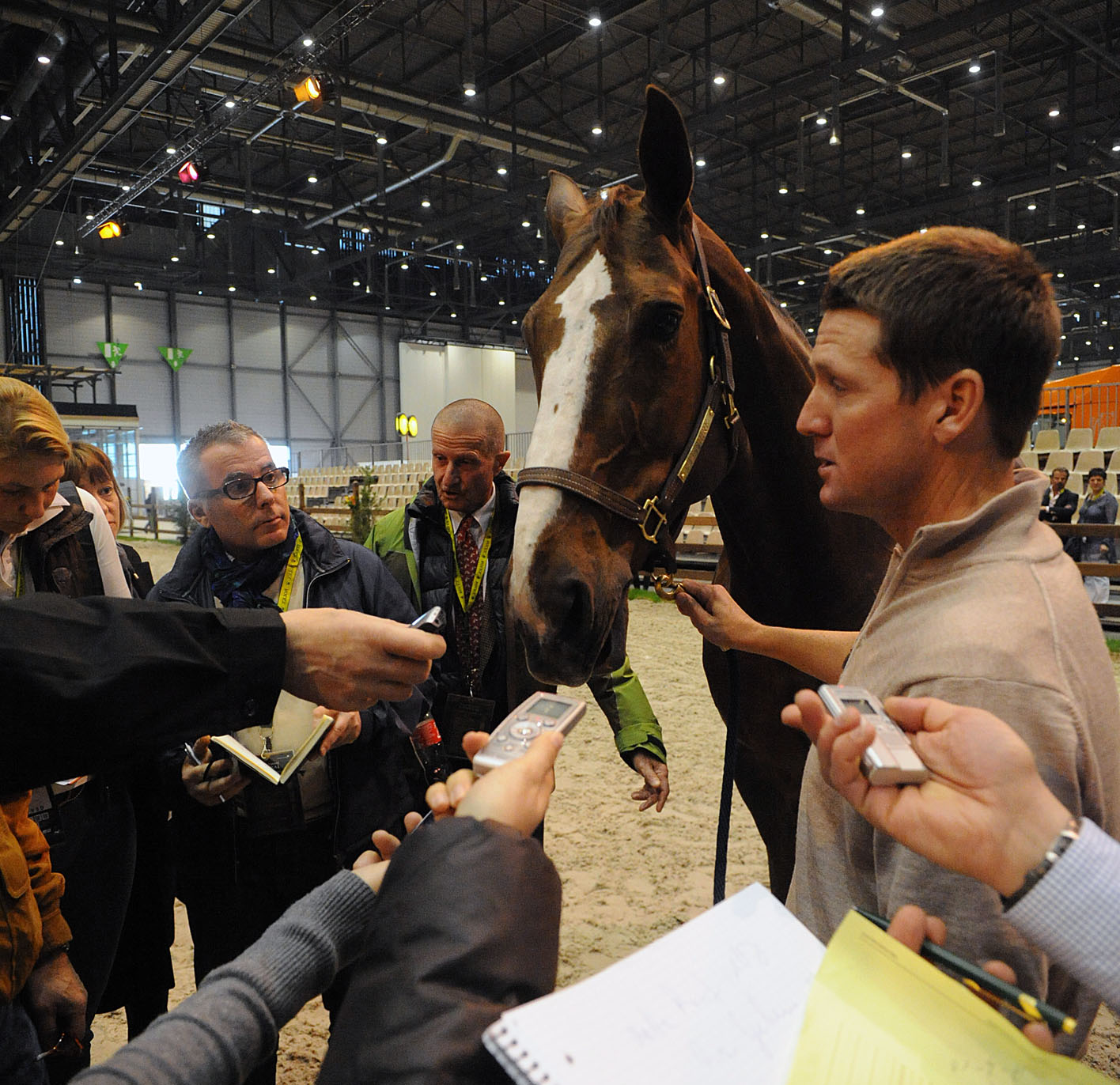
In an effort to explain the controversial decision to eliminate Sapphire from the Rolex/FEI Show Jumping World Cup Final, the Fédération Equestre Internationale held a press conference this afternoon, April 17, at the Palexpo Arena in Geneva, Switzerland.
A huge crowd that included journalists, riders, trainers and other curious equestrians packed in to hear why late last night the FEI decided to disqualify McLain Ward’s mount from Round 2 following a hypersensitivity test.
Sapphire and Ward had just jumped two clean rounds to finish second in the class leaving Ward standing first in the World Cup Final. The FEI also decided to eliminate Sapphire from the rest of the competition.
FEI President HRH Princess Haya, clearly distressed at the developments, opened with a prepared statement, then fielded questions alongside FEI First Vice President Sven Holmberg, President of the Ground Jury René Billardon and FEI-appointed veterinarian Paul Farrington, DVM.
Just The Facts
Farrington administered two hypersensitivity tests on Sapphire, one at 7:30 p.m. just at the start of Round 2 of the competition, and the second at 12:30 a.m., about two hours after the end of the competition. Both times Farrington and Foreign Veterinary Delegate Emile Welling performed a thermography exam and clinical exam with identical results: The thermography test came back negative, but the clinical exam showed sensitivity in a small area on the dorsal surface of the pastern on her left foreleg.
During the second exam, a third veterinarian, Markus Mueller of Switzerland, and Billardon were also present.
“Each and every time I touched that point on the surface of the horse’s pastern, the horse showed a very marked reaction by picking the leg up very sharply and stamping it down to the ground,” said Farrington.
Despite Farrington’s concerns, Sapphire was not eliminated before the class. That decision must be made by the Ground Jury, who was presiding over the class at the time and could not leave the jury box to make a decision at that moment.
“The vets also felt in light of the type of investigation that had been carried out, the horse could jump,” said Holmberg. “The fact that the Ground Jury didn’t have the immediate possibility to attend to the horse was also one of the reasons the horse was re-inspected five hours later.”
As per protocols, the second examination was filmed, and that video will be used in case of a further investigation. The FEI declined to make that video available to the public.
According to Holmberg, the Ground Jury decided to wait so long for the second exam and to eliminate Sapphire out of prudence.
“In light of the graveness of the eventual decision, we felt it was necessary make sure the protocol as decided by the General Assembly was followed to the letter, and it took some time to get all that organized,” he said.
Sapphire was not the only horse tested for hypersensitivity at the competition. Indeed, according to Farrington, some 35 horses had been examined before Sapphire, starting on the Thursday of the competition, and some of them were examined twice. And 30 horses have been examined since then.
“Every single horse was examined by thermography, and every single horse by clinical exam, one by myself and one by Dr. Emile Welling, the Foreign Veterinary Delegate,” said Farrington. “We had no problems with any of the examinations up to that time.”
There is no appeals process for an elimination based on hypersensitivity.
But What Does That Mean?
According to the FEI, hypersensitivity is a subjective condition. The thermography testing that the Fédération uses as part of the hypersensitivity testing plays a less-important role than a “clinical exam” (palpating the leg).
ADVERTISEMENT
“If a bee stings you, you’re going to be hypersensitive,” said Farrington. “A horse can get cast in a stable and injure a leg. It is then going to have hypersensitivity to palpation.”
Hypersensitivity does not mean lameness, and in fact a trot-up is not part of the FEI protocol for determining whether a horse is hypersensitive. Increasing the sensitivity of a horse’s legs, i.e. hypersensitizing them, may cause the horse to jump more carefully. But hypersensitive legs have not been necessarily manipulated.
“That’s the unfortunate situation; a horse can become hypersensitive through purely accidental means. It can hurt itself,” said Farrington. “Once that hypersensitivity is there, then obviously we have to look to the well being of the horse.
“It’s an entirely clinical judgment,” he went on. “It’s based on clinical experience, and that’s why not only was it my experience that was put to the test, but also the experience of two other very well-known equine vets. In terms of the level of reaction, that is exactly the same way we would assess pain at our practice. In other words, assessing the response of the horse to a physical exam.”
The FEI took great lengths to emphasize that right now neither Ward nor anyone in his camp is suspected of malpractice or maladministration to the horse. Sapphire underwent so-called NCP testing of her blood and urine the morning after she was disqualified. Results of the test are not yet available.
“I would like to reiterate that we have made every effort to be absolutely clear that we have not put any blame at all on McLain himself,” said HRH Princess Haya.
The FEI would not rule out charges against Ward should the NCP tests reveal any abnormalities.
“We did not have any evidence that anything had been done to the horse deliberately,” said Farrington. “We were just considering that the horse was showing signs of hypersensitivity.
“At this moment in time we’re not talking about a doping case, and we are not talking about hypersensitization, which is a deliberate attempt to make the horse hypersensitive,” he continued. “The horse is being NCP tested, and in that respect if a positive test came back then obviously the goal posts change.”
Ward’s Reaction
With the elimination of Sapphire from Round 2, Ward fell from the top of the rankings down to 24th, well out of contention. He is still eligible to compete, but his only other mount at the show, Rothchild, isn’t eligible as he hadn’t entered any World Cup-qualifying classes in the season.
“I saved my other horse [Rothchild] for the [U.S. World Equestrian Games Selection Trials] because we actually are good horsemen and don’t show every week,” he said.
If Ward sounded a bit bitter, it’s because he was. He’s been aching for an individual championship, and with his horse-of-a-lifetime under him, and two top contenders (Jessica Kürten and Meredith Michaels-Beerbaum) sitting out this year’s edition, Ward, 34, was the odds-on favorite heading into the competition. In many ways, this looked to be his year.
Ward openly considers himself an easy target for persecution from the FEI, with his father, Barney Ward having pled guilty to involvement with the horse-insurance fraud scandal of the 90s and McLain himself havng been sanctioned with an eight-month suspention by the FEI in 1999 following an incident in which stewards claimed to have found plastic chips in his horse, Benton’s, boots at the 1999 Aachen CHIO.
“I have history in my family, and I had trouble 10 years ago; it’s no secret,” he said frankly. “But [I’ve had] 10 years of successful show jumping since then without any incident. The horse has been at the top of the sport for several years [and helped the U.S. team earn gold at the 2004 and 2008 Olympic Games] and still going strong. She’s the most well-cared for horse in the world. She only jumped 16 times last year. How many other grand prix show jumpers jumped 16 times? Sixteen times! And she was the leading money winner for the year.”
Ward’s anger extended beyond just his own disappointment at a chance at a championship falling away.
“This is a very dangerous direction for our sport to go in, when the horse is in perfectly good shape and perfectly healthy,” said Ward. “They clearly said there was nothing maliciously done to hypersensitize the horse. They refused to have the horse fully inspected—she was never even jogged. This decision is absolutely shocking.
“I welcome tests throughout the competition,” he continued. “For people who do this sport well, clean sport is the best, and I’m very comfortable to compete this way. We are all aware of the testing that’s going to take place. Sometimes it’s a little more extreme than others and sometimes you feel more targeted than others, but you understand that. I certainly think that 57 times probing with the intensity was excessive.You would get a reaction out of any horse, especially a horse of quality like this, who is sensitive. She’s a thin-skinned horse.”
ADVERTISEMENT
Others Chime In
Indeed riders and horsemen seemed uneasy at the concept that they also could be eliminated based solely on a subjective decision like this one. Rumors of a boycott of the competition (and impending lawsuits) abounded, but Ward made it clear that he wouldn’t ask riders, U.S. or otherwise, to do that for him.
“They’re all chasing the same dreams as I am, and I don’t see the benefit to ask four or five riders to do so,” said Ward. “Maybe if all 29 refused to show that would be a statement, but that’s difficult to ask. They have obligations to sponsors and huge financial commitments. That’s a lot to ask of somebody. I would never ask that of them because I’m sure they wouldn’t ask that of me.”
U.S. Equestrian Federation show jumping team veterinarian Tim Ober, DVM, disagreed completely with the FEI’s decision and assessment. He was present during the examinations and reviewed the video of the second exam afterward.
“We took the time to count the number of touches to the legs,” he said. “There were 33 touches of the right forelimb, and she moved her limb in response on three occasions. There were 24 touches of the left forelimb and she moved her limb in response on four occasions.”
To Ober, the mare’s reaction seemed reasonable, and indeed, even Farrington admitted that she was getting fed up with all the prodding by the end, but he insisted that they accounted for her irritability.
“After the competition, she began to show reaction on the right fore, but we believe that was just because she was starting to get fed up with us,” said Farrington. “We’re very aware that when you have to give them repeated injections on a daily basis eventually they decide they don’t want to see us. But the reaction on the left front was consistent with both examinations.”
Rich Fellers was one of five riders who met with John Roach, Holmberg, Farrington and Billardon. He watched the video and did not agree with the FEI’s interpretation.
“I listened to the explanation of the vet before I saw the video, and I have to say that what the vet described when he palpated that specific spot—he described a specific spot on the front of the left fore and that she had a very exaggerated reaction and slammed her foot down,” he said. “I anticipated seeing her pick it up and slam it down on the video, which I’ve seen a horse do before when they’ve had a similar procedure and are very irritated in a specific spot or sensitized. In the video she picked her foot up and put it down, and it did not look like what I was anticipating, the way he described it.”
George Morris, chef d’equipe of the U.S. show jumping team, was in Geneva to lend a hand during the competition. The FEI’s ruling had him seeing red, and he dubbed it at various points “hasty,” “subjective,” “arbitrary,” “wispy” and “disgusting.”
“There was no substantial evidence of any kind,” he said. “What the reviewers should also hear—maybe they’re not horsemen—is that this is a chestnut mare.”
1978 Volvo World Cup Finals runner-up Katie Prudent was in town to watch the championship, and she voiced her complete disagreement of the ruling.
“If they thought she was unfit they should have said ‘Sorry, McLain, she’s unfit,’ ” she said. “Instead they said, ‘OK, go.’ Clearly she was fit because she went beautifully. She came out, tested the same, and then they say, ‘No, she’s unfit.’ There is something that smells of dishonesty to me here.”
Fellow World Cup competitor Todd Minikus thought the ruling equally unsensible.
“What people are forgetting is that a horse is constructed to be able to feel a fly land on its leg,” pointed out Minikus. “Fact or fiction? It’s fact! If a horse can feel a fly land on its leg, it definitely can feel someone poking its leg, whether it’s a horse out in the pasture, or a wild horse running in the hills of Nevada…I think this is a tragedy for the sport in general, and that as usual I often question the credibility of the people involved, the controllers of our sport and the veterinarians that may be selected to do the panels. “
What do you think? Put in your two cents here.
For more news, photos and lots more preview information about the FEI/Rolex World Cup Final—including more reports on the FEI’s ruling against Sapphire—check out the Chronicle’s World Cup page. And check out this video of the USEF-sponsored press conference featuring Morris, Ober and Ward.