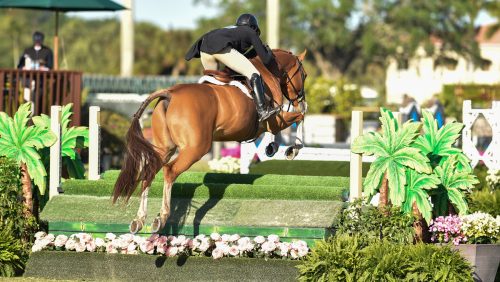
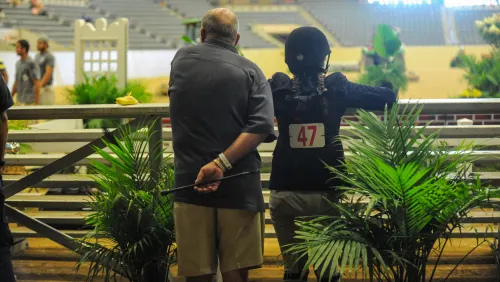
If you watched Sophie Tyack jump around to a championship in the modified adult hunters at the Fieldstone Summer Showcase (Mass.) at the end of August, you’d never guess that two years ago she was unable to feel her torso and legs, let alone move them.
Tyack started to experience some pain in her lower back during the summer before she started college at Princeton University (N.J.), but her rigorous schedule of rowing crew in high school made her believe it wasn’t anything to worry about.
The pain increased to what felt like a “cracked rib” during her fall semester, and her new crew coach prompted her to get the scan while she was home over Thanksgiving break.
The MRI revealed that Tyack had a benign growth inside her spinal cord.
“[The doctors] originally thought it was a hematoma, and they were all ready to rush me into emergency surgery, but they realized it wasn’t,” said Tyack, 20. “It’s called a lipoma. They said I’d had it since birth, but it gradually grows, and it hadn’t bothered me before. By the time I had my MRI, it had smashed my spinal cord to 50 percent of its size. They couldn’t believe I didn’t have neurological symptoms.”
She returned home to Hanover, Mass., a week early for her Christmas break, and doctors told her that recovery from the surgery, which would be performed with a laser, would be about a week. Risks named were anesthesia or infection in the incision.
“They have no idea really what happened. I woke up the next morning [after the surgery], and I couldn’t feel or move anything but my arms,” she said. “Originally, I thought they were just asleep, because I’d just been lying there, not moving for quite awhile. But then they asked me to move my foot up and down, and I thought I was, but I wasn’t—I freaked out.”
It turned out that Tyack had suffered a reaction from the titanium screws the surgeons had inserted—she had a crew training trip the following January, and she wanted to be ready for it. However, in order for the screws to be placed, a small piece of her spine had to be removed. The swelling from that act proved to be responsible for her inability to move anything from her shoulders down.
Even after a second surgery to remove the pins and flush out her swelling and a week in the intensive care unit, Tyack’s doctors were still unsure of her future.
An Uncertain Future
“After a week in the ICU, I could kind of move one of my toes,” Tyack recalled. “Originally they said that with the whole thing, I’d just be in the hospital for a week; it wasn’t supposed to be a problem. The doctors would come in, and they just didn’t know anything—they didn’t know what happened, they didn’t know if I would get better. They had no answers for me at all. It was totally frustrating.”
Tyack’s family spent the 2009 holidays at her bedside. Friends came to visit while they were home on breaks from school. Tyack said the support from her friends and family, as well as the fact that everyone remained positive, really helped her keep her spirits up as she started physical therapy. In a matter of two weeks she’d lost nearly 20 pounds, mostly muscle, from having lain immobile.
“I had been lying down for so long; I just wanted to sit up. They said I shouldn’t, but I felt like if I could get vertical, I’d be fine. But when I finally got them to let me sit up, it was a major struggle because I couldn’t move my trunk. I got sitting up on the side of the bed, and I totally passed out.
ADVERTISEMENT
“I’ve always been really active—healthy,” continued Tyack, who is the captain of Princeton’s Intercollegiate Horse Show Association team as well as a member of their club field hockey team. “I’ve never really had to go to doctors. Lying in bed, you don’t really notice how much is wrong with you.”
Although she recalled noticing very little day-to-day improvements with physical therapy, promising signs came after a week of working to flex her joints, particularly her knee, in attempt to rebuild connections with her spinal cord.
“They would ask me to bend my leg at the knee, and it would twitch, so it was an improvement,” said Tyack. “[Doctors had told me that] spinal cord cells cannot regenerate, but sometimes they go to sleep for a little bit, so they said the fact that I was getting some [movement and feeling] back was a good sign—and I’d get more back as time passed.”
After 2½ weeks at The Children’s Hospital in Boston, Tyack relocated to Spaulding Rehabilitation Hospital, which has a spinal cord injury rehabilitation program. There she spent time working on specialized machines that helped her spinal cord recall actions like the pattern of walking.
“When I left [Spaulding Rehabilitation Hospital] in [February 2010], I had a walker to balance myself,” said Tyack, who began working out at the local YMCA as soon as she was able. “I could kind of move by then, but I couldn’t really feel anything. It was just so bizarre—having the littlest things be so hard—I’d been in pretty good shape before, but I couldn’t put my socks on. Just all of the sudden, the most normal things were just so hard.”
Determined To Get Back In The Tack
And one of those normal things in Tyack’s life was riding. Getting back in the saddle proved to be a struggle, but Tyack was determined.
“I got out of the hospital and the first thing I really wanted to do was see my horse,” said Tyack. She traveled down to Ocala, Fla., soon after being released so she could visit with her horse, Flamenco 135, who was leased at the time to another student of Tyack’s trainer, Tom Hern. “And once I was back at the horse show again, I just kept thinking, ‘I really want to get back on a horse. How long until I can get back on?’ ”
It didn’t take long. Hern and his wife Amy, along with other students at Kingsway Farm in Halifax, Mass., assisted Tyack as she acclimated herself once again to riding astride a horse.
Even as Tyack continued to recover, her body revealed that she was lacking proprioception, or awareness of where your body is in space.
“You don’t really know where your legs are in space, which now doesn’t really bother me unless it’s really bad footing or it’s dark out. It was mostly just adjusting—I use vision a lot to balance,” said Tyack, who first started riding a school pony, Lucky, bareback. “If somebody touches me on the leg, I can kind of feel it, but once I got back on, it kind of threw me. Because it didn’t feel like I was sitting on anything—it was like I was just floating up there. But the muscle memory was all still there, so once I got used to the new feeling it was alright.”
Ironically, Tyack had actually rehabbed the pony from a suspensory ligament injury, and Amy, the barn manager, said Lucky totally understand what was going on.
“Lucky knew his job. Sophie was really unbalanced. That’s been her biggest hurdle. It was completely different to retrain herself,” said Amy, whose husband has been training Tyack since she was 11.
ADVERTISEMENT
Slowly but surely, Tyack began to get herself back into riding shape, but she had to deal with some changes, like needing to ask for help or be sure she had supervision while riding.
“I had to learn how to trust that my legs were going to do what they were supposed to do,” she said. “I’d squeeze [my legs to get the horse to move forward] and tell myself what to do, but I don’t really know what they’re doing. It would work out most of the time, but once in a while, if my leg would slide back, I wouldn’t really notice until it threw my upper body off balance.”
Because of the lack of feeling in her legs, she’d often lose her stirrups, only to realize once she came out of the ring and someone alerted her of it. Buying magnetic stirrups helped solve that problem, and it wasn’t too long until she started working over fences again.
“[Starting to jump again] was really exciting. In my first jump lesson I just cantered a little crossrail, and it felt totally normal. And then I went to my first horse show, and the horse took a longer distance to one of the oxers, and I just wiped out on the other side. That was when I was l like, ‘OK, it’s not totally normal,’ ” she joked. “It took a while to get used to that. I never used to have to think about my half seat, but now I do. I have to make sure I’m centered; I have to think about what I’m doing.”
“She’s hard on herself,” said Amy. “And she’s not the kind of kid that would vocalize that she’s frustrated. She had to work a lot harder just to stay on a horse.”
After spending a good deal of time riding Lucky and other quiet horses at the farm, Tyack reunited with her own “Coco,” a 13-year-old Rhinelander gelding. During her high school years the pair had shown in the children’s hunter and junior equitation divisions, but in their first show back together, the Vermont Summer Celebration this August, the duo campaigned in the modified adult hunters, where they won a class.
“I was really nervous at the beginning [of trying to ride after the surgery]. When I first got on, and it felt so weird, I was like, ‘Oh no,’ ” she said. “I’ve always loved the horses, loved riding, and that was the first thing in the hospital I thought about. I was scared then that I wasn’t going to be able to ride anymore.”
Tyack is now in her junior year at Princeton, and she’s studying classics and environmental science.
“I don’t do crew anymore,” she noted. “And I really don’t mind. I’ve always liked riding the best of everything I’ve done, and I didn’t want to make my back hurt so that I couldn’t enjoy doing what I really loved.”
“I think being around the horses made her feel comfortable,” said Amy, who admitted that she and her husband were seriously worried that Tyack wouldn’t recover enough to ride again. “And she just really loves it. She’s not one of the ones who rides only to win, but she ends up doing so well because she truly enjoys doing it. She has her priorities straight.”