Lexington, Ky., Jan. 24
In 2010, Courtney King-Dye’s traumatic brain injury made equestrians take note—and helmet rules passed in dressage and eventing at this year’s U.S. Equestrian Federation Annual Meeting with little muss or fuss.
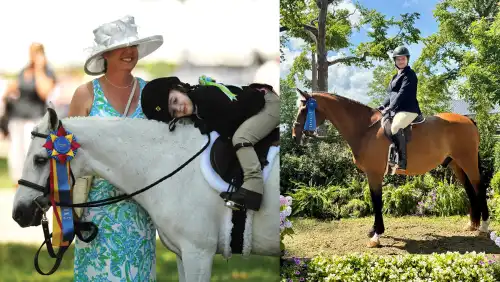
Effective March 1, 2011, DR 120 requires all riders at fourth level and below to wear ASTM/SEI-approved helmets at any time while mounted on competition grounds. Additionally, all riders under 18, all para-equestrian riders and all riders on non-competing horses must wear helmets. When a horse is competing at both the national and FEI levels, its rider must wear a helmet at all times, including in any FEI tests.
“It’s a step in the right direction even if we think they don’t go far enough,” said Malcolm Hook, co-vice chair of the USEF Safety Committee, which approved the rule with a notation that they support requiring ASTM/SEI helmets for all riders.
In eventing, EV 114.1 is even more strict. It mandates helmets be worn by anyone on a horse at all times, to be effective immediately. As this is a USEF rule, FEI rules allowing top hats would take precedence at FEI competitions.
Eventing and dressage are likely just the first of the USEF breeds and disciplines to move toward stricter safety mandates.
“The time is now for a lot of these things,” said David O’Connor, president of the USEF. “The hunter/jumper guys are going to be next. I think you could write a rule, have everyone scream for two weeks, but then you won’t hear about it. It’s a longer time away for some of the breeds, who haven’t shifted their culture. As an industry, we’re the third largest head injury group there is. It’s hard to argue we still want our personal freedoms.”
Hook, an eventing official from Aurora, Ore., and O’Connor emphasized the importance of educating breeds officials so that they decide to require helmets rather than being forced by the Federation.
Safety First
Rules regarding safety didn’t stop with helmets. According to rule EV 113.2, any rider with even brief symptoms of concussion, without loss of consciousness, will be suspended for seven days from competition. Any loss of consciousness will require a 21-day suspension.
Riders who have established a baseline cognitive skills level (e.g. through an IMPACT test) may return to competition upon submitting to the Federation confirmation that they have passed this exam and have no impairment of their baseline cognitive skills.
The computerized IMPACT testing (Immediate Post-Concussion Assessment and Cognitive Testing) is used by all National Football League and National Hockey League teams, as well as 31 Major League Baseball teams.
Although it wasn’t added to the rule, Hook suggested that USEF require High Performance riders get a baseline cognitive study. “You can take the test and get back to competing with the medical assurance that you don’t have serious damage,” he said. “This would be a step toward educating the general membership.”
ADVERTISEMENT
Jumping For (How Much?) Money
A heated debate took place over the issue of prize money, thanks to a proposal from the Jumper Committee that would require competitions with a jumper rating of 5 and 6 to increase the percentage of prize money as the difficulty and height of the course increases.
The proposal was tabled until the summer meeting in August.
Larry Langer explained that the North American Riders Group had presented this rule change to the Jumper Committee every year for the last three years.
But Bob Bell, chairman of the Competition Management Committee, said competition managers disapproved of this, as some sponsors want to give money to a specific class, which isn’t always the class with the biggest fences.
“That’s the whole idea [of this rule],” said Executive Board member Alan Balch. “You’re standing horsemanship on its head and standing some children and adults on their heads, racing for $50,000. I think this is a big issue, and we all know why it happens. I question the horsemanship aspect of it, especially when we’re trying to develop show jumpers to compete internationally, not to sell horses to amateurs so they can stand on their heads.”
To Banamine Or Not?
In anticipation of the rule limiting Non-Steroidal Anti-Inflammatory Drugs to one, which will go into effect on Dec. 1, a rule addressing the emergency use of flunixin (Banamine) for colic or an ophthalmic emergency will also take place on Dec. 1. GR 411.3 will allow a veterinarian to administer the drug in an emergency situation but would require a medication report if the horse had received a different NSAID within three days prior. The horse would then be able to compete in 24 hours.
There was some question as to whether a veterinarian needed to be the one to administer the drug. Would this make it impossible to treat a horse that was colicking en route to the show? What if a veterinarian was on call elsewhere and couldn’t get to the grounds quickly enough to humanely ease the horse’s discomfort?
“I’m concerned that people wouldn’t give Banamine because a vet was not available, and that horse has got to show, because it’s a year-end championship or something,” said Jane Clark. “[Could there be] language that says a horse must be ‘attended to’ by a vet?”
But Dr. Mike Tomlinson said the Veterinary Committee wanted to ensure that a veterinarian actually saw the horse if it was still going to compete. “We want to do what’s right for the horse,” he said. “I’m afraid if we say ‘on order of a vet’ the potential for abuse is too high.”
The rule change passed with the proviso that it be sent back to the Veterinary Committee to deal with emergency situations.
Other Rules Of Interest
ADVERTISEMENT
– Anabolic steroids will be banned across all breeds and disciplines, to be effective December 1, 2011.
– A change to rule GR 1301.8, proposed by the USHJA, clarifies that in emergency situations, competition management may authorize treatment of a horse on competition grounds, with management and veterinarian indemnified from action.
– A rule proposed by the USHJA allowing riders in hunters and hunter seat equitation to stop and secure chin straps, without penalty, while competing passed. GR801.3
– Keep a tight leash on dogs and children: Changes to rule 1301.6 put dog owners as solely responsible for any damages resulting from the dog’s behavior at a show, and 1301.7 puts responsibility for a minor driving a golf cart or other motorized vehicle on the parent or guardian. “This is not intended for the courts but for our own rules and complaints filed,” said show manager Bob Bell. “We’re trying to run horse shows; we can’t go after every dog or golf cart, and these things tie up the hearing process.”
– The much-debated change to the amateur rule proposed by the USHJA Amateur Committee (dubbed the “Oh My God” rule because of its length) was deferred to the summer meeting.
– A rule change proposed by the U.S. Pony Club to allow members to teach while also maintaining amateur status did not pass. “I’m concerned other groups are going to come in and want exemptions like this,” said Janine Malone.
– Rule HU106, defining the pre-green hunter division and adding a re-instatement clause, passed.
– HU158, establishing the order of go for hunter divisions, also passed.
– HU170.4 prevents a steward from measuring horses or ponies owned by family members, significant others or clients.