
With talented and versatile offspring showing up in every discipline, it will be a long time before this Hanoverian stallion is forgotten.
Augustin Walch’s life changed forever the day he spotted a gangly, bay 3-year-old standing in a barn aisle in Verden, Germany.
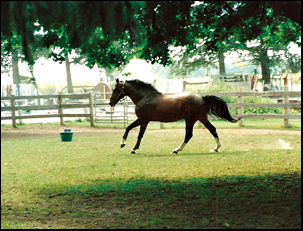 He couldn’t get the colt out of his mind and decided to bid on him by phone a week later after returning to Canada. He never dreamed that his spontaneous purchase would turn into an international athlete and top sport horse sire.
Today, Rio Grande is almost a household name for those who follow show hunters. His get have won at all the biggest shows and topped the U.S. Equestrian Federation national standings. Sadly, Rio Grande died on May 21 from heart failure at age 21, but his impact on sport horses in North America will be felt for some time to come.
Walch believed that God led him to Rio Grande. “Something blesses me when it comes to horses,” he said.
A German immigrant to Canada in 1980, he closely consults pedigree when buying breeding stock, but it wasn’t “Rio’s” ancestors that initially captured Walch’s attention.
“There’s always an exception to the rules,” he said. “When I see something that says, ‘buy this,’ then I do it.”
Walch was in Germany after nine years in Canada to see if he was on the right track with his breeding program at W. Charlot Farms in Stratford, Ont. He visited the Holsteiner and Oldenburg verbands, and then he found Rio at Verden.
“I bought a program and looked at a couple of horses,” he recalled. “I saw Rio in the aisle, but I never saw him be ridden.”
But that one glimpse of the Hanoverian colt (Raphael—Wandra, Windhuk) was enough for Walch.
As it turned out, Rio did have quite a stately pedigree. His sire, Raphael, produced multiple international show jumpers including Richard Spooner’s Robinson, Rene Tebbel’s Radiator and another Raphael that Eric Lamaze rode.
And Rio’s grandsire, Ramiro Z, has produced countless show jumpers, including Olympic gold medalist Ratina Z.
A Promising Start
Once Rio arrived in Canada, he soon began to prove himself by winning the Basic Dressage Championship at the Tournament of Champions as a 4-year-old. The following year he won his stallion performance test with 135 points. He scored 134 for his jumping and 130 for his rideability, but the judges were impressed with his flatwork as well.
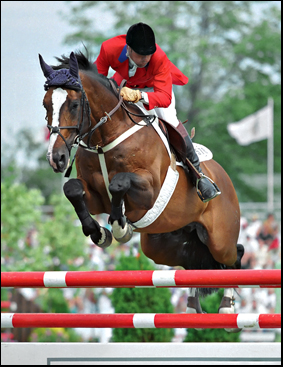
“He could have been a dressage horse as well as a jumper,” said Augustin’s wife Christine. “They discussed it at the stallion testing. But it’s a much faster road to become a successful jumper than it is to be a Grand Prix dressage horse. He showed a little bit in the hunter ring as well.”
Although Augustin mostly employed others to show Rio, he did undertake some of his training.
“He was a Cadillac to ride. You could really lengthen him and shorten him,” he recalled. “But when he was young he was a handful. He was like a young boy.”
Rio’s jumping career hit its stride under Eric Lamaze. He showed him from 1994 to 1997 as a grand prix jumper and was on Team Canada for two Nations Cups wins. He also won a class at the 1995 Royal Agricultural Winter Fair (Ont.) and placed second in the Shell Cup Derby at Spruce Meadows (Alta.). He qualified for the 1996 Atlanta Olympics, but Lamaze was unable to attend.
Rio then went on to win U.S. grand prix classes with Jenni Martin. “I loved riding him,” she said. “He was one of my most favorite horses to ride. I wish every day I had another one.”
Martin won her first grand prix with Rio at HITS Tahoe (Calif.). She said he inspired confidence in her every time she went in the ring.
“It was the first time I went to the ring thinking I could jump any course,” she said. “If the jumps were huge and the combinations were big, it didn’t matter. It didn’t matter what they built that day.”
Although Martin rode Rio at the end of his jumping career, she said she was still able to build a strong relationship with him.
“I always felt that he was a superstar, and he knew that I felt that way,” she explained. “He tried his heart out and gave me a little extra because he knew I appreciated him. We respected each other. I loved having him around. He was very special.”
The Proof Is In The Offspring
ADVERTISEMENT
A great stallion isn’t necessarily measured by his accomplishments though, but those of his get. And because the Walches believed in Rio, they bred him to a lot of their broodmares from an early age.
“[Stallions] don’t usually get busy until they’re old, and then the semen is not very good,” said Christine. “ It was different for Rio because we breed so many horses every year, and he got most of our mares at the time. When we first started breeding we had about 15 mares, but today we have a total of 40.”
So, unlike many stallions, who don’t start breeding until they’ve finished their sport horse career, Rio babies have been proving his quality for years.
Currently, Augustin is on top of the U.S. Equestrian Federation national standings for leading hunter breeders, and he’s been there since 2004. That’s mostly due to the Rio babies he’s bred.
One example is Rio Bronco, who was the 2002 USEF Amateur-Owner Horse of the Year and 2002 and 2003 Amateur-Owner Hunter, 18-35, Horse of the Year for Stepping Stone Farm.
“Some of the nicest young horses I’ve ridden have been by Rio Grande,” said Martin. “The babies I’ve had could always jump really big, but they’re so pretty, and they move well that they don’t make it past the hunter ring. All the ones I’ve ridden have jumped big jumps anyway. They’re quiet, super movers, beautiful and good jumpers.”
This year there are 10 Rio offspring listed with USEF that are earning points for him in the hunter ring, but it’s not just the Rio jump that puts them in the ribbons. It’s their quiet attitude that makes them so suitable for amateur riders.
| These Rios Would Make Their Father Proud
Victoria Watters LeBlond is legally blind, so she’s pretty careful when it comes to But Eye Remember Rio, a 12-year-old, Hanoverian gelding (Rio Grande—Sandros Girl), has won her heart and dozens of adult amateur titles and tricolors for LeBlond. Their latest victory came at the Pennsylvania National Horse Show where she won blue in the NAL Adult Hunter Finals. “He’s quite the family horse,” said LeBlond. “My mother trail rides him. My 9-year-old took two or three rides on him this summer and decided that’s his horse. He doesn’t want to ride his pony anymore.” LeBlond said he’s the best horse she’s ever ridden. “You ride him with your fingertips,” she said. “He’s so flexible. You can add two steps or leave out two strides. Nothing fazes him. I could make him jump into a standard, and he’ll forgive me and go on with the rest of the course.” LeBlond’s eyesight certainly leaves her at a disadvantage when it comes to finding her distance, but her “Rio” more than makes up for her. “I can go a little long, a little short, a little left or a little right, jump up his neck, and his confidence isn’t shattered,” she said. “He jumps it the same way. If I’m a little bit off on my angle, Rio will cover it up for me.” And LeBlond is so happy with Rio that she decided to breed her mare, See 4 Yourself, to Rio Grande. Their filly, Out To See, was born last spring. Brad Wolf is just as passionate about his Rio, Rio Renoir. “I have never sat on a horse that canters as smoothly as him,” he said. “I rode him in this little bitty ring for the first time. It was like sitting in a rocking chair. You can tell that when he goes around the ring. It’s a perfect, smooth rhythm, and it helps me find the jumps.” Wolf and the 9-year-old Canadian Sport Horse (Rio Grande—Dunja) took home grand amateur-owner honors at the Devon Horse Show (Pa.) this spring, the first time that Wolf had competed at Devon. “It took me many months to just hang on over the jump,” admitted Wolf. “I was sort of a beginner, but it never bothered him a bit. I could chip, miss, and do all kinds of things, and it doesn’t faze him. I’ve chipped so badly that I almost fell off, and he’ll canter down to the next jump. He will clock me around the ring like there’s no tomorrow.” |
“He knew he was a special horse,” said Christine. “He was the king of the barn. He had a great mind. He wasn’t difficult to handle. He was a pleasure to ride.”
Because the Walches bred so many Rio foals, Christine and Augustin have a good feel for how they generally turn out.
ADVERTISEMENT
“They’re easy to start, easy to ride, not spooky,” said Christine. “They’re very trainable and rideable.”
They had actually stopped using Rio too much for breeding to their own horses at the end of his career because so many of their broodmares are his descendents.
“The temperament is key because 95 percent of our horses are ridden by amateurs at some point,” explained Christine.
“When the horse has the willingness to perform and do everything, it doesn’t matter how he looks,” agreed Augustin. “The nicest horse, if he doesn’t want to work, you can do nothing.”
Another hallmark of Rio Grande offspring is their versatility. Although his hunter get are the best known, there are many Rio jumpers out there and even some Rio dressage and event horses.
Catwalk is one of his best-known jumpers. Out of a Landgraf mare, the 10-year-old, Oldenburg mare, ridden by Darren Dlin, led the Jump Canada Series in September after victories in the $70,000 Grand Prix Jumping du Quebec World Cup Qualifier held at the Blainville CSI-W (Que.) and the $100,000 Caledon Equestrian Park World Cup Qualifier (Ont.).
In the dressage world, a Canadian Warmblood named Grande Crimson (Rio Grande—Ruby II) is making her mark. Last year she took home top honors in the central region USEF/Markel Young Dressage Horse Selection Trials in the 6-year-old division (Ohio).
And Rio’s even made his name known in eventing. ‘R’ Kameo won the Wit’s End CIC* (Ont.) this summer.
“We’re trying to breed athletes that are versatile and not specialists,” said Christine. “We just came back from Europe, and now they’re acknowledging that it’s good to have a little bit of jumping blood in the dressage horses and vice versa.”
She explained that one of the reasons so many Rios have done well in the hunter ring is that people are most likely to buy a 3-year-old hunter prospect.
“It’s tough to sell a 3-year-old jumper prospect. People want to see them go in the ring,” she said. “Most are sold to the U.S. We get a lot of calls for older horses, which we don’t have.
“It’s usually an owner-trainer combination that buys the younger ones and brings them along and then sells them again when they’re ready to go in the ring,” she continued. “Then they come back and buy another young horse!”
“He Put Us On The Map”
Augustin and Christine know they owe much of their business success to Rio.
“He was everything for us,” said Augustin. “When you have good horses, all of a sudden people know you. He put us on the map.”
Rio’s achievements meant he basically marketed himself. “How many horses win the stallion performance test and then have an international career?” asked Christine.
His death came as a shock to everyone, as he’d been very healthy until the moment he collapsed.
“At least it was incredibly fast,” said Christine. “We didn’t have to make the difficult decision for putting him down. He still looked great. He never looked like an old horse.”
Augustin believed that the same divine presence that initially guided him to Rio also told him to come home for his death.
“Before he died, I drove down to Florida,” recalled Augustin. “I arrived on Friday. All of a sudden at 1 p.m. I decided to drive home again. I hooked up the camper and by 3 p.m., I was on the road going home to Canada. I was home on Saturday by 5 o’clock in the evening. On Monday morning he died.”
Normally he would’ve stayed a few days in Florida to rest before making the long trek back to Canada, but Augustin said that something told him he would be needed at home.
Rio’s legacy will live on in the hundreds of horses he’s sired, and specifically in Rio’s Filius, who will carry on his bloodline as a stallion at W. Charlot Farms.
“He looks like Rio,” said Christine. “He has a lot of qualities, three good gaits, a lot of jump, he’s a very impressive horse.”
But no horse will truly replace Rio Grande. “He was a very special horse for all of us,” said Christine. “He made us.”
Sara Lieser


