The 2020 Olympic Games were supposed to begin on July 24 in Tokyo, but they’ve been postponed a full year due to the novel coronavirus pandemic. We’ll be highlighting memorable Olympic equestrian moments all this week and next, starting with this personal account of the horse that would help William C. Steinkraus become the first American to win an Olympic individual equestrian gold medal at Mexico City in 1968.
I first learned of Snowbound’s existence from the lips of John (later Sir John) Galvin, the Australian-born benefactor of both the U.S. and Irish equestrian teams.
“I’ve found a horse that might make you a useful hack,” he told me, using a vernacular term he often employed. Like many of his remarks, this one proved a considerable understatement.
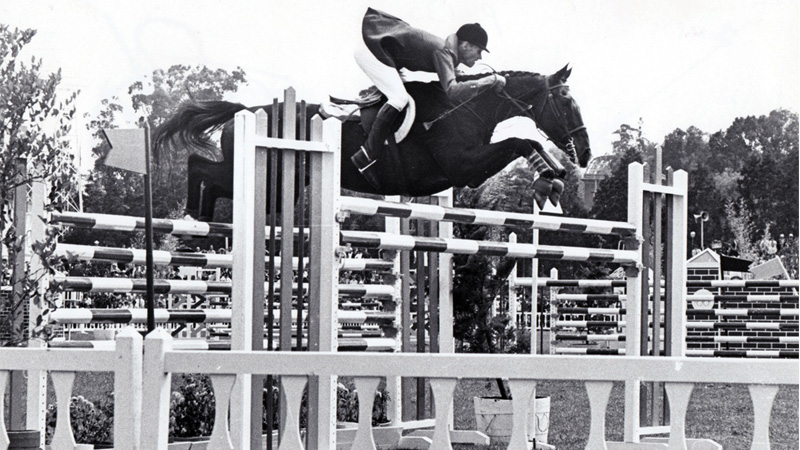
Snowbound and Bill Steinkraus had to jump this massive oxer on their way to the individual gold medal at the 1968 Olympic Games.
John Galvin was a very canny judge of a horse, and when he reckoned that a given individual was of Olympic caliber, he wasn’t often wrong. A number of Galvin’s choices were made available to the U.S. Equestrian Team and shown in the name of his American-born wife or his daughter, Trish (later the Princess de la Tour d’Auvergne).
These included Rath Patrick, who won the dressage Grand Prix at Aachen (Germany) in 1960 with Trish in the saddle and was sixth in the 1960 Rome Olympics; Night Owl, who won Aachen’s show jumping grand prix the same year with George Morris riding; the giant San Lucas, Frank Chapot’s Olympic mount in 1964 and 1968, when he placed fourth; and the astonishing little express train, Grasshopper, Michael Page’s mount in the 1960 and 1964 Olympic three-day event. Yes, John Galvin knew an Olympic horse when he saw one.
Galvin had happened upon Snowbound in California, where he was being shown as a green working hunter by Sacramento’s famous all-round champion rider Barbara Worth Oakford, also a noted dealer and instructor. She had rescued Snowbound from the Northern California flat-racing circuit, where it had taken him three years to “break his maiden.”
This lackluster career could probably be attributed to temperament, for Snowbound was easily upset, didn’t like company, and never hesitated to let you know how he felt about things.
More serious, however, was his history of tendon trouble, which was to continue to bother him on and off long after his racing career had been forgotten.
Snowbound was so gymnastic, and so extravagant with his jumping abilities, that he would sometimes simply place more strain on his physical structure than it could tolerate. He also struggled in off footing, being a horse who jumped more through spring than through strength.
Snowbound arrived at the USET’s headquarters in Gladstone, N.J., in early 1964, at age 6, and both Bert de Némethy, the USET’s legendary coach, and I really liked him the moment we laid eyes on him.
He was a dark bay gelding, measuring a scant 16.1 hands high, by Hail Victory out of Gay Alvena (hence his registered name, Gay Vic). He was a paternal grandson of the celebrated English sire Blenheim II, and had jumping blood on both sides of his pedigree.
Snowbound had a short back, a beautiful shoulder and a lot of “front,” and he moved like the natural athlete he was, with a stride that could extend almost effortlessly. Galvin was first struck by the ease with which Snowbound could leave out strides on hunter courses, and basically he could do it wherever and whenever he felt like it.
No Problems
As a jumper, Snowbound didn’t have much more than a good foundation when we first put him in work. But since Bert always started the year by concentrating on flat work with all the horses, and working over cavalletti and small fences, it was easy for Snowbound to fit in. As the fences got a bit bigger, and then bigger still, he kept up easily, and nothing ever seemed to pose a problem for him.
When the time came to ship to Europe to give the older horses some competitive sharpening prior to the Tokyo Olympics, there was no reason not to take him along.
ADVERTISEMENT
Snowbound had a wonderful summer in Europe, jumping a lot of slow, clear rounds in the speed classes as he got to see the whole range of European show-jumping obstacles—banks, ditches, water and all kinds of natural and artificial obstacles.
Nothing ever fazed him; indeed, I can’t recall that he ever stopped at a fence in his entire career, and you could count the faults he had over water on one hand.
By the fall he was ready to move up, backing up Sinjon in my string. He ended the year with a sensational victory in the Grand Prix of New York at Madison Square Garden to help me clinch the leading individual rider award. Clearly he was up to anything’if we could just keep him sound.
With this in mind, he became a horse that we always “spotted”—he never showed in novelty classes or the puissance, but was saved for the Nations Cup and the grand prix. So reliable did he become in Nations Cup competition that in one stretch he jumped 15 clear rounds in 16 attempts, always jumping the “anchor” round.
In the fall of 1966, he won two individual classes in Harrisburg (Pa.) and one in New York before developing a suspicious filling in his tendon and being retired for the show and the season in favor of Bold Minstrel.
Back in form again the following year, I showed him only lightly in Europe. But he had another formidable fall indoor circuit, being faultless in Harrisburg’s Nations Cup and never incurring a single fault during the entire run of New York’s National Horse Show, to match the performance of his stablemate Bold Minstrel. (The latter had to jump a then-record 7’3” in the puissance to keep the string of clear rounds intact.)
You Just Never Knew
In preparing for the 1968 Mexico Olympics, Snowbound again had a marvelous European tour, jumping critical double-clears as we U.S. riders won all of our Nations Cups, including Aachen, London and Dublin, and we also won London’s coveted Daily Mail Cup with the only clear round in the jump-off. It was one of the most thrilling rides I ever had over a very big course.
However, in that summer’s last show, at Hickstead (England), he struggled a bit in some heavy going, and we had to withdraw him for the balance of the show.
It was ever so. Snowbound never really bowed—he would only “threaten” to bow—and after a rest, he’d come back perfectly sound, his tendons looking cosmetically perfect, as if they would never cause any problem, ever again. But you just never knew.
“Snowburger,” as groom Dennis Haley affectionately nicknamed him, schooled perfectly for Mexico. By then he could handle any kind of distance problem, jump any kind of angle, and never lay a toe to a fence as high as he could jump.
We never tried to see how big a fence he actually could jump. My guess is that he would have had to struggle to jump 2 meters (6’7”). But within the range of his scope, he was just an exceptionally clean and versatile jumper, and as game as horses come. You felt you could ride him through the eye of a needle and that if you pointed him at a house, he’d try to jump it.
The individual competition in Mexico City consisted of two rounds, the first over a big and very technical Nations Cup-type course of 14 numbered obstacles (including two doubles). Only the best 15 competitors plus ties came back for course B. That course had only six numbered obstacles (including a double at the end), but all the dimensions were at or near the maximum then allowed by the rules. (They have since been moderated).
The wall was set at 6 feet, and the fifth fence was a monstrous oxer, with the top rails set at 5’9” and 6’0”, and a spread of 7’3”. You really have to build this fence to appreciate how huge it actually was.
A Test Of His Temperament
ADVERTISEMENT
Perhaps the biggest test for Snowbound actually came before he ever started on course. I have already mentioned that he had lots of temperament—one never really knew from day to day which Snowbound he would be—and as luck would have it, the very first challenge of the day was a temperament test.
As Snowbound waited in the collecting ring, getting ready to warm up, a high Mexican official arrived right there by helicopter, with a brass band to welcome him!
Snowbound’s warm-up was ragged at best, for he was very much distracted, and the picture of us jumping the first fence shows a horse entirely on the curb rein. In fact, as I entered the ring, I worried that he might not look at the fences at all. As it happened, though, he was all business the moment he saw the first fence and really jumped marvelously, bailing me out when I got him a little long to the Swedish oxer. And he solved all the distance problems as if they weren’t there.
After the first round, only two had remained clear, Snowbound and the fabulous little British pony, Stroller, with Marion Coates. By the time we went in the second round, I knew Stroller had had two fences down. Thus I knew we could afford a single mistake—almost the whole field had faulted at that huge oxer—and still win the gold outright. Two fences down would mean a tie and a jump-off, though.
Snowbound was clean coming to that yawning oxer. His valiant attempt just tipped it off behind, but it had taken a huge effort, and as I made the turn to the double, I could sense that something was not quite right. Yet, somehow, summoning up all his courage, he jumped the double cleanly and then pulled up on three legs. The gold medal was ours.
Click the link below to watch video of that amazing performance.
Naturally, Snowbound missed the fall circuit that year, but in due course the tendon recovered, and over the next three years he jumped many more wonderful rounds for the team. (I was especially pleased when he collaborated with Fleet Apple to win Aachen’s famous combination class, a two-horse competition in which you changed horses with the clock running, which had eluded me for almost 20 years.)
We all knew that it was problematic for Snowbound to try to defend his title at the 1972 Munich Olympics, so we had decided in advance that if he wasn’t himself in the individual competition, I’d switch to Main Spring for the team competition. Snowbound did finish the individual leg, but he pulled up unsound again. Main Spring, however, had the good fortune to turn in the best two-round score in the team event, and we ended up with the silver team medal, beaten by the German team by only a quarter time fault.
We retired Snowbound, now 14, after Munich, especially as his rider was scheduled to retire at the end of the year too. He returned to John Galvin’s beautiful farm outside of Dublin and enjoyed a well-earned life of ease until he died.
Originally published in the Feb. 20, 2004, issue of the Chronicle, Bill Steinkraus’ memories of Snowbound, the horse that earned the United States’ first Olympic individual equestrian gold medal, never gets old.
To see more great content, please subscribe.
Subscribers may choose online access to a digital version or a print subscription or both, and they will also receive our lifestyle publication, Untacked. Or you can purchase a single issue or subscribe on a mobile device through our app The Chronicle of the Horse LLC.
If you’re just following COTH online, you’re missing so much great unique content. Each print issue of the Chronicle is full of in-depth competition news, fascinating features, probing looks at issues within the sports of hunter/jumper, eventing and dressage, and stunning photography.
What are you missing if you don’t subscribe?