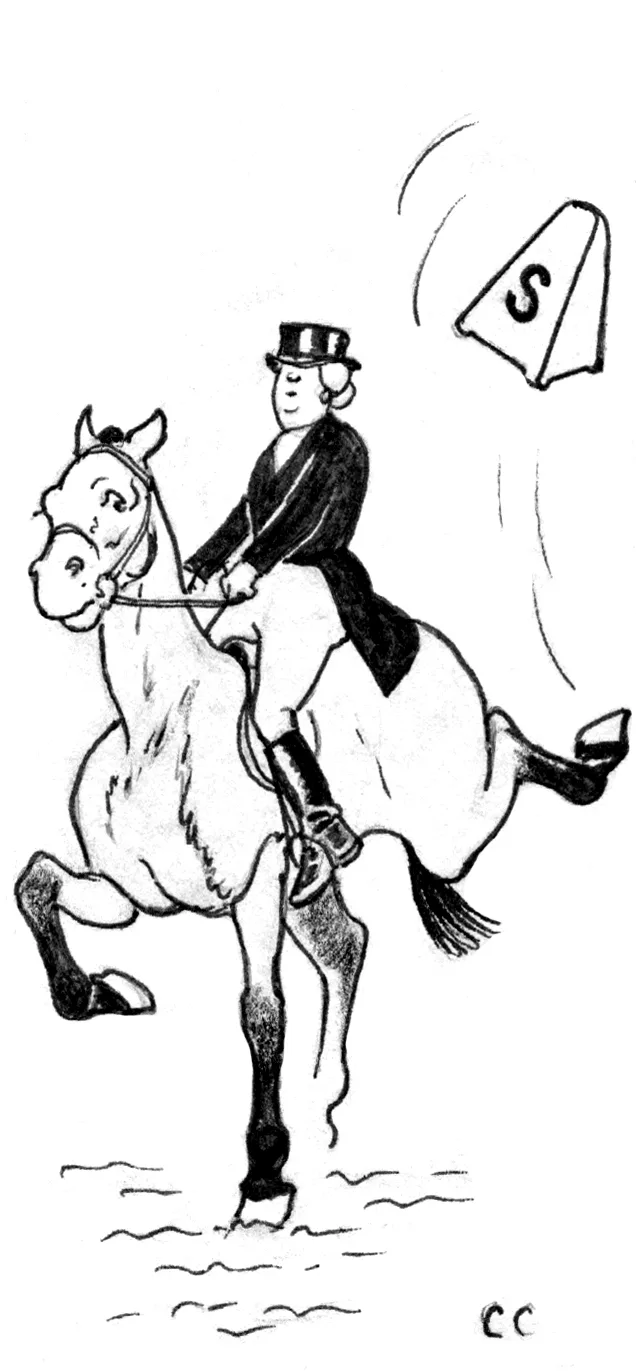
Any time I’ve ever scribed for a dressage judge, the dressage test requires marks for “transitions to” various gaits. The judge is called on to award scores for the smoothness, energy and accuracy of the transition, whether from trot to canter, canter to trot, changes between collected and extended gaits or what-have-you.
Transitions are intended to be invisible, as seamless and effortless as possible, making it look like the horse is flowing into one gait from another without a jerk, rush, stumble or other noticeable interruption. If only life transitions could be so seamless and effortless.
When we start to learn to perfect our transitions, our teachers explain the principle of the half-halt. The half-halt is designed to get the horse’s attention and warn the horse that something new is coming. Life also dishes out half-halts. Life has a way of warning us that we’re not in Kansas anymore. Some half-halts are more obvious than others.
The first life transition I remember clearly is returning to the States from abroad and going to public school for the first time. My parents were both diplomats, and we had gone to convent schools in our various stints in other countries.
The protocol in convent schools is simple and is hammered into you from the first day—the nuns are treated with respect. So here I was, entering a public high school in a major city in the middle of the year, fresh from the convent. It was the first time in my life that I’d gone to school not wearing a uniform, which was enough of a change. Then, as the teacher (who was, by the way, not wearing a nun’s habit!) entered the room, I did what I’d been taught to do—I stood up. That lasted all of about 10 seconds, as I looked around and realized that not one single person in the room was standing except me. Half-halt and proceed working humiliation.
Once I got settled into school, I found a barn near my home. My father rode in the cavalry, and there were always horses around wherever we went. Horses were a link from the past to the future. Riding was a constant in my life and kept me anchored to reality (or at least my version of reality). I landed at a sales barn, and the owner let me ride a lot of her sale ponies. Since I was not the most polished rider of the group of us kids, I tended to get assigned the rough stock, the half-broke ponies and the ones that needed attitude adjustments. Track sideways, medium buck.
Riding those ponies helped me develop a seat like glue, decent hands (a lot of those ponies went better the less you fussed with their faces), horse and stable management skills (we kids did all our own show prep, braiding, bathing, tack cleaning, as well as general stable chores in exchange for extra riding) and confidence in my ability to get almost any pony over any jump given enough time.
Extended Intimidation
Which did very little to prepare me for the transition to college. It was a very, very fancy college, academically rigorous and full of girls from astronomically wealthy families. Some of the girls in our riding program had ridden in the huge fall indoor shows, had trained with some of the biggest names in the country, and, at least in one case, owned a horse that was scouted for the USET. Was I ever out of my league. Change rein at extended intimidation.
ADVERTISEMENT
On the other hand, my background meant that I happily rode the horses that nobody else would get on, as well as our kind but very ordinary school horses. They were a definite step up from the unmannerly beasts that I’d been working with. I enjoyed being able to get on a horse that I didn’t have to guard against and could work on improving my own riding, rather than the more fundamental issue of staying aboard. I was considered odd because I thought our school horses were nice, safe and pleasant rides. My life transitions were getting a little better because I learned that if I didn’t reveal everything I was thinking, people just thought that I was a little clueless but easy to please. I learned in a half-halt moment that it doesn’t hurt to be underestimated.
Being underestimated stood me in good stead a lot of times when I returned from Horsemasters school and got a job working for a lesson and sales barn. I rode a lot of their sale horses in demonstration rides, because people see what they want to see, and I rode a lot better than I looked on a horse. Circle, width of arena, smirk.
The transition from jumpers to eventing was seamless and smooth, mostly because the trainer I worked for emphasized dressage in jumper training long before it became the fashion. I’d been handed the tools I needed early on. And since we boarded at a facility with access to a national forest, my horses had spent a lot of time in the open, jumping ditches and splashing happily through streams and gullies. Cross-country turned into a frolic over manicured courses, a far cry from our training ground and much safer and more comfortable than home.
Change Of Location
A work-related move and a major life upheaval (that one without a half-halt in preparation) took me to the West Coast, where I experienced several transitions at once. I’d come from forests and weather-related riding restrictions to southern California, where the only weather problems were rising heat in the summer, and the trails led into the canyon country behind the barn. I learned there what a pack of coyotes sound like at nightfall when they start singing about a hundred feet behind your horse (time to depart the area quickly). I learned that in the middle of a drought, the tarantulas come down off the high hills around the barn looking for water, and that horses do not like tarantulas.
My next life transition was another job-related move, this time away from southern California and its incredible climate (there was one lovely evening in January when I called my bff in Colorado to complain that I’d had to wear a sweatshirt to the barn that night for my lesson. I thought she was going to come down the wire and strangle me—they had 3 feet of snow and a 30 below wind-chill). This move took me to the horse capital of the world, lovely, lovely Lexington, Kentucky. Simple change of location.
Talk about culture shock. Eventing in California consists of nine-hour trailer trips to anywhere. To quote Gertrude Stein, “there is no there there.” Lexington seemed like heaven in comparison—we could do a dozen events with less than three hours in a trailer and, if one was lazy or on a tight budget, six of those were events that didn’t require leaving the home barn.
And the space! In California we had access to some trails, yes, but access was restricted because of movie shoots. Half the westerns you’ve seen recently were shot on our canyon trails. In Lexington, I found that if you scooted across the highway at the end of the farm drive (that was a trick because there was a half-mile downhill slope to the right, and the semi-rigs came down the hill at Mach IV) and jumped the coop into the pasture on the other side, you could trot for 45 minutes in a straight line and never once hit a road again. Bliss. Smooth, effortless transition to heaven.
The drawback to that freedom, and another transition I had to learn, was to watch the weather. It’s lovely to be able to do your trot work without worrying about roads, but as soon as you get complacent, sure as shooting a hailstorm pops up when you’re at the apogee of your ride, and there’s not a shelter in sight. Life is like a posting trot. It has its ups and downs.
ADVERTISEMENT
Moses, my wonderful event partner, retired. I received my next serious half-halt in the transition to a new horse. For a short while, I had a young horse, which, as the plan read, was going to be my step up on the road to a three-day career. To quote Lao Tze, “No battle plan ever survives the first encounter with the enemy.” We were doing a last school for the first event of the season, and we got in wrong to a decent-sized fence. I’d been riding Moses for a long time, long enough to know that if I got him badly wrong to a fence, I needed to throw the reins away, kick like mad and hang on while Moses got us out of what I’d gotten us into. Wrong move on a young horse. I released the reins and kicked, and the young horse mentally looked over his shoulder at me and said “huh?” For that moment of stupidity, I spent 12 weeks in a cast. Reinback three months.
The young horse developed some problems that caused him to move on (another story for another day), and then came Margie. Serious half-halt, kick in the pants and club over the head.
Reconsider At X
The previous injury and follow-up rehab work made me reconsider upper-level eventing as a pastime until I learned how to judge distances a little bit more accurately. Since correct distances are the be-all and end-all of the hunter world, I thought that it might be intelligent to learn how to ride a smooth and polished round at preliminary and intermediate eventing fence heights before going back to the wild and wooly world of eventing.
The amateur-owner hunters sounded like the right place to begin, and a top trainer happened to live close by. I wanted a packer to introduce me to this new discipline, and I knew that such a horse was going to be expensive. After a long hunt, we found Margie. She was picture-book perfect, cute as they come, talented and well-bred. Yeah, right. She also had a mean streak a mile wide, a vicious buck that unloaded me at the in-gate of our first show, and a fighting disposition that signed her walking papers when she tried to unload my trainer. She went to a dealer the next day, a very expensive mistake, and another half-halt.
The transition to Cameo was like caramel. Cameo was an off-the-track Thoroughbred, royally bred, who came to us in the middle of a Midwest snowstorm. Her handler, a friend of my trainer, was on his way to Florida with a load of yearlings for a sale and stopped at our barn for coffee. Cameo had been included in the load for this dispersal sale because she wasn’t working out as a broodmare. The man pulled her out of the trailer, handed the rope to his friend, my trainer, told us to find her a home and left with the snow still coming down hard.
She turned out to be the most maternal mare I’ve ever dealt with. A while after I bought her, we happened to have an animal communicator in to talk to our horses. The woman asked Cameo if she liked her job and what that job was. After recovering from an attack of giggles that left her breathless, the woman told me that Cameo had told her that she had a foal. It was a nice foal, but not real bright and a bit clumsy, not really very prepossessing, but it was her foal, and she had to look after it. The picture that Cameo sent to the woman was: me. And that was the way Cameo treated me the entire time I knew her.
There was this one time … I’d had a horrible day at work and shouldn’t have gone to the barn at all, much less tried to take a lesson. We were going to work over some interesting courses, so my trainer had us trot over a cross-pole to warm up. When she realized that my mind was miles away and that I was still brooding, Cameo intelligently opted to stop in front of the crossrails. I slid off over her neck and ended up sitting on the ground between her front feet. Cameo looked down at me, then looked over at my trainer, then back down at me and gave an enormous sigh that said, clear as words, “Can’t you DO anything with this one?” It took my trainer minutes to get his breath back from laughing at me.
Ah, life’s little half-halts, sometimes little tweaks, sometimes a club over the head. Life certainly knows how to get our attention.
Kathie P. Mautner grew up as a “Foreign Service brat,” and now she works as an insurance attorney and competes in ballroom dancing. Her horse experience includes eventing, dressage and hunter/jumpers as well as volunteering as a Pony Club D.C. “I’m a survivor of ponies of all sizes,” said Mautner. She also writes humor pieces for the Chronicle recalling her mispent youth as well as a serious column every now and then.