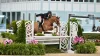
Germany’s reigning dressage queen Isabell Werth is back in the show ring after giving birth to her first child Frederik last year. Throughout her preparation for the Alltech FEI World Equestrian Games she posted periodic diaries, and this is the conclusion. Read her thoughts about the WEG, the sale of Totilas, and her upcoming plans, courtesy of Rolex.
Q. What have you been up to since the Alltech FEI World Equestrian Games?
A. I’ve been very pleased with how everything has gone since the WEG, notably my wins in Odense, Denmark, (with Satchmo), in Lyon, France, (with Hannes) and in Stuttgart, Germany, (with El Santo).
Each competition went very well, and my horses are in great form. When we were in Stuttgart, I rode El Santo in the freestyle to music by Roberto Blanco—the one from Aachen. It’s fun, and it’s different to other music, and that made it exciting! Then for the last qualifier in Frankfurt, Germany, I’m actually not sure which horse I will take—Satchmo or Hannes.
Hannes was in good shape when he got back to Germany from the WEG, and I was surprised he had no problems and how fit he was. Quite soon after he arrived home he was back to his normal fitness. He wasn’t necessarily as supple as he should have been, but in general I was really happy.
However, I could tell that Hannes was getting bored and that he was desperate to compete, which is why I took him to Lyon. He can be really awkward sometimes—he’s biting, he’s kicking, he’s running around—he ignores me, and he just does his own thing and doesn’t really listen to me! Then it’s as if he is shaking his head and he’s running away—so it’s quite funny when he starts to become bored.
He’s a real character in the respect that he can be really strong, and it’s something that’s completely out of my control.
Q. What were your thoughts on the WEG?
A. I was really impressed with the showground in Lexington, and it was amazing to see all of the different disciplines, horses and riders together in the Horse Park.
ADVERTISEMENT
But, I think because of the size of the event and the venue, it was difficult for the organizers to get everything under control and please everyone involved. But that’s a question of experience, I think.
They also had a hard time as everyone compared Kentucky to Aachen four years ago. Aachen was just outstanding, so it was a tough act for them to follow. There were a lot of positives to take from the event, and overall I was happy with my experience there.
Performance-wise, we were happy to get the team bronze medal, although we were hoping to get the silver. Laura [Bechtolsheimer] was so strong [for Great Britain], and we were happy with the overall result. Next was the Special, and for me there was no real chance for an individual medal. But I said, “OK, I will give everything I have.”
I was faultless for the whole week, and then I made a few mistakes but that’s the game—at the end it doesn’t matter if you are fifth or 10th.
To be honest, the scoring was a bit strange. I don’t think that’s a secret, and I don’t think it’s impolite to say that differences of 8-10 percent between the judges are not acceptable. No one was happy about it. But OK, it happens.
The problem that we, the riders, have with these inconsistencies is when the judge or the judgment makes a difference to the medal standings, and this isn’t fair at all—something has to be done.
I really didn’t expect to get the bronze medal, but when I saw the mistakes of the other riders, I said, “OK, it’s not the time to be angry or worry about it.” The most frustrating thing is that I can’t see a solution to [the scoring]. I was really pleased for Edward [Gal], which was the most important emotion in the end—joy for fellow riders.
Q. What were your thoughts on Laura Bechtolsheimer and Edward Gal?
A. Laura was super in the Grand Prix with one of the best tests I have ever seen. I thought she was going to win, and I don’t think I was the only one thinking that. It shows that it’s not always one horse that is going to win, and this ultimately makes the sport exciting.
ADVERTISEMENT
I don’t think she was as good in the Special as in the Grand Prix. I didn’t see [Mistral Hojris] in the freestyle, but the horse is super. He and Laura grew up together; they are very close now—a great partnership. In the past they had a lot of good competitions, but they were never as close as they are now. I think with the experience and confidence they have gained from the WEG, they will be the top favorites for the World Cup, and then we’ll see what happens further into the future.
As for Edward, I was very disappointed by the sale of Totilas, and I felt very sad for him to lose an incredible partner. No rider wants to lose his horse, especially such an iconic horse such as Totilas. I can’t imagine what it would be like if I had to sell Satchmo—it’s not even worth thinking about.
Q. Anything you want to add?
A. The transition from outdoor to indoor competitions has been quite easy. Odense was a very big showground with a lot of space, so it’s easy for the horses to start there.
Satchmo went quite well, but he was a bit tense in the Grand Prix. However, in the freestyle he was relaxed and put in a very encouraging performance.
Don Johnson was easy—I worked him in the morning, and he was a bit spooky, but then I competed him in the Prix St. Georges, and he was very good there.
We have also just bought a 6-year-old Oldenburg, Laurenti, who I think is a super horse, just brilliant—very huge, very powerful and with a lot of energy and presence.
With my horses in good form and an exciting season ahead of me, I am thoroughly focused and full of confidence.
Read Part 1 and Part 2 of Werth’s interviews.
Isabell Werth has represented Germany in multiple Olympic Games, World Equestrian Games, European Championships and FEI World Cups. Most recently she won team and individual gold at the 2008 Beijing Olympic Games, she captured the 2007 World Cup Final in Las Vegas, Nev., and earned team and individual gold at the 2006 FEI World Equestrian Games in Aachen, Germany. She is a Rolex equestrian sports Testimonee.