The New York hunt had a rich history that continues today in South Carolina.
If one listens carefully as the Aiken Hounds (S.C.) move off, the notes ascending from the huntsman’s sterling silver horn can be heard in another time and place.
The horn, which was handed down through generations, is the same that blew for the East Aurora (N.Y.) hounds in the early 20th century, proving yet again that in the timeless tradition of foxhunting, history often repeats itself.
 Creating A Bright Spot
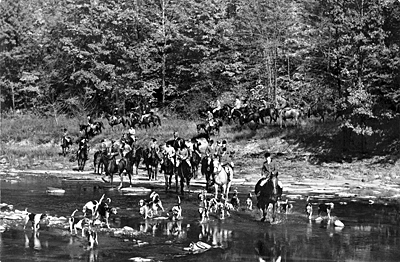
During the dismal years of the Great Depression until World War II, the East Aurora Hunt flourished in Western New York State, just southeast of Buffalo. According to a 1968 article that appeared in the East Aurora Shopping Guide, “The hunt was colorful, not only because of the scarlet coats but also the excitement it brought to the area each fall . . . It was a new source of village pride with everyone learning to share the exuberant interest of the huntsmen.”
In 1930, the country of the Lake Shore Hunt Club—a New York hunt that existed from 1920 to 1933—was divided and the East Aurora Hunt began. In the beginning, East Aurora shared MFHs—Howard Kellog and William C. Warren Jr.—with Lake Shore.
But by 1932, Mrs. Seymour H. (Helen) Knox and Mrs. Reginald B. (Cecelia “Peach”) Taylor took over as joint Masters of the East Aurora Hunt, and it is their legacy that reverberates in today’s equestrian community.
Knox’s granddaughter, Linda Knox McLean MFH, hunts the Aiken Hounds, and Taylor’s grandson is Mason Phelps Jr., the chairman of the National Horse Show Association and an alternate for the 1968 Olympic eventing team. Phelps started his eventing career riding his grandmother’s homebred field hunters, to the envy of other cross-country competitors.
The Masters of Foxhounds Association Executive Director Dennis Foster said that the National Steeplechase and Hunt Association, which still held records of hounds at that time, recognized the East Aurora Hunt on Jan. 1, 1932. Hunt colors were dark green with orange facings. There were two professional huntsmen officially listed, Frank Vinall (1932-34) and Fred Yull (1934-39).
According to Yull’s nephew, Robert W. Yull, following Fred Yull’s premature death due to polio, his cousin Don Yull, Sr., briefly took up the horn. Fred’s father Paul, a longtime hound man originally from England, was professional whipper-in. But throughout East Aurora Hunt history, it was the Knox family that provided the club’s foundation. A mid-1930’s article from a Buffalo newspaper noted that “hunters gathered at the kennels on the Knox estate,” known then as Ess Kay Farm.
Seymour Horace Knox was the Buffalo, N.Y., businessman who made his fortune in five-and-dime stores when he merged his more than 100 stores with those of his first cousins, to form the F.W. Woolworth Company and then used his merger proceeds to purchase a controlling interest in the Marine Trust Co. (today HSBC Bank USA). His children, Seymour H. Knox II, Marjorie and Dorothy and their spouses were avid equestrians.
ADVERTISEMENT
Seymour II played polo along with his friend Reginald B. Taylor. And while they were both also foxhunters, it was their wives—Helen and Peach—who led the East Aurora Hunt.
Meanwhile, Marjorie Knox married Hazard Campbell, who whipped-in, and her sister Dorothy married Charles Goodyear and following his death, Edmund Rogers—both vital hunt
members throughout the decade.
Notes For Posterity
While the Knox family provided the cornerstone for East Aurora Hunt, jt.-MFH Peach Taylor, who actually lived in Buffalo, documented its prosperity, thereby creating a historical record.
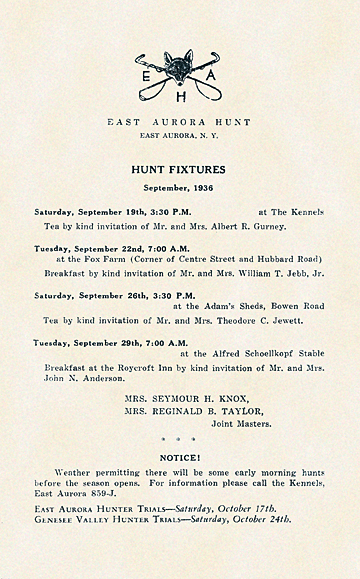
A diary she kept in 1936—and later shared with the 57 active members who were out during the season— shows how little the sport and its traditions have changed in the subsequent 70 years. The book chronicles the date and time of each fixture, including bye days, who was out and on which horse they were mounted, how the hounds went, the weather conditions and amusing anecdotes from the field.
Of course at that time, the 20-by-20-mile countryside that hunters galloped across was wide-open fertile farmland located southeast of Buffalo where farmers welcomed the riders. Today, East Aurora is a prosperous historic village of landmarks, and the surrounding former hunt country, while still somewhat open, is ringed with busy highways and other development.
The diary paints a picture of a sport that is both familiar and forever lost.
The anticipation of a day of hunting hasn’t changed. On opening day, “a good-sized crowd met at the kennels and the old thrill was back in the air,” Taylor wrote. Three days later, the jt.-MFH notes, “even at 5:45, it was black as pitch, but fun to grope around the house when everyone was asleep—quite a different feeling from coming in after a dance. Then, it is all over, and this way all is in the future and the day is tinged with excitement.”
East Aurora Hunt was a drag pack that consisted of approximately 40 English, American and Crossbred
hounds. Taylor’s pride in the pack infused her diary entries. Following a perfect day, she noted, “we stopped at the kennels to talk things over with Freddie [the huntsman]. Everything seems fine, Dido’s litter of 12 puppies was out in the sun—they must all have names beginning with ‘D,’ which will be quite a job.”
Comments on individual hounds also are scattered throughout. “Hoot did himself proud, setting a fast pace with his nose well to the ground.” “We had Drummond and Diligent out—it was their first hunt. Pat took them home in the car after the first check because they are still pretty well undeveloped.” “Shorty and I went on barging through the mud at top speed followed by Delight, giving grand tongue by herself.”
There are notes on things of bygone days. Diary entries indicate how active the U.S. Army Remount Service was in the East Aurora Hunt. Several riders were members. On Oct. 10, 1936, Taylor noted that “the Army was out in force.” And on Nov. 7, “the 121st Cavalry [located in nearby Orchard Park] gave a delightful tea at the Roycroft Inn.”
Almost every entry references the “grooms” among the field. Robert W. Yull, who at age 83 now lives in Geneseo, N.Y., remembers the days when his father, Robert M., was one of those hunting grooms. Robert M. Yull trained the Goodyears’ horses. Dorothy Goodyear was Yalor’s sister-in-law. After Mr. Goodyear was killed in an auto accident, Dorothy married Edmund Rogers and Yull continued to train for them. “My father worked for the family for 25 years,” Robert Yull said.
A Hunter Looks Back
ADVERTISEMENT
The hunting diary references many foxhunters, including Jane Merritt Hitchings. Hitchings, perhaps the only remaining foxhunter from East Aurora Hunt at age 89, has spent her entire life in East Aurora. Her father, Haines Merritt, was president of the Griggs and Ball feed mill, where most people purchased their horse’s grain as well as the feed for the East Aurora hounds.
Hitchings’ equestrian adventures began at age 7, when her father accepted a pony named Riley as payment for feed. She began hunting Riley, but he couldn’t jump. She recalled that “there were approximately 25 members out at any one time and only one flight, but there were lots of gates. Mrs. Knox and the others were oh, so nice to us. She showed us where the gates were located, and their horses were beautiful,” Hitchings said.
She hunted a number of horses and even took one to Bennett College in Millbrook, N.Y. “My father went to the Goodyear’s home to buy a horse and had it shipped directly to Bennett. Of course, no one ever tried the horse and my riding instructor did not like the horse because he would stop,” Hitchings explained.
But Bennett maintained a small pack of hounds, and she went out with them. Students also were “invited to hunt with Millbrook Hunt [N.Y.] and my riding instructor, Mr. Bowden, matched riders with horses,” she said. Hitchings also hunted with Genesee Valley Hunt (N.Y.) as a guest.
After college, Hitchings joined the U.S. Navy as part of WAVES, the Women Accepted for Volunteer Emergency Service program. While stationed at the naval base at Quonset Point, R.I., she and a friend drove to Millbrook. She recalls attending the elegant hunt tea in a wonderful manor surrounded by woods.
Hitchings stopped riding in her 60s but continued a relationship with horses through the Lothlorien Therapeutic Riding Center in East Aurora.
Today, she still proudly displays a memento that is a piece of East Aurora Hunt history, a lovely silver-serving spoon with the EAH logo on the handle. “Mr. Bassett gave the spoons to each person who hosted a breakfast or tea following the meet,” she said.
The Aiken Connection
With the advent of World War II, foxhunting in East Aurora began to subside. Robert Yull believed that gasoline rationing was the primary reason. So, the transition to Aiken, S.C., came almost naturally.
“In the mid-1930s, my father started going to Aiken,” Yull said. “They [the Rogers] took two train-loads of horses, all the hunt horses, and they stayed until May of the next year.”
According to Linda Knox McLean, the Knox family began going to Aiken in the mid-1920s and had a home there. Family members grew roots in the community. Helen Knox also became a Master of the Aiken Hounds. Seymour and Helen Knox had two sons, Seymour Jr. and Northrup, the latter marrying Lucetta (Crisp) whom he met while wintering in Aiken. Lucetta is Linda Knox McLean’s mother. The hunt horn McLean blows today belonged to her grandmother and is inscribed, “To Helen North Knox given with affection from the field, 1935,” a sentimental testament to the glory days of the East Aurora Hunt.
Donna Ross