
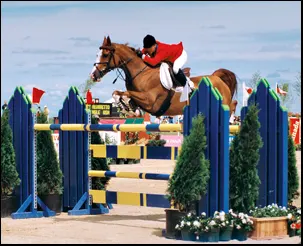
Warmbloods carry a brand specific to their type, signifying lineage and quality. Here’s how to identify some of the most common and how they came to be.
Watch any national or international competition, and you’re sure to find countless warmbloods in attendance. Shaped by European history and named after monarchies and regions, the warmbloods
of today appeal to equestrians due to their athletic ability and attractive style.
As a horse that continues to evolve, warmbloods aren’t classified as a “breed” like a Thoroughbred or Arabian. The open studbooks and tradition of introducing foreign bloodlines have created a type of horse that excels in many disciplines, whether it’s a Hanoverian, Holsteiner, Oldenburg or any other type of warmblood.

Hanoverian
One of the most popular is the Hanoverian, a breed that originated from northern Germany in the state of Lower Saxony, the former kingdom of Hannover.
For the past 400 years horse breeding has flourished in the area, and many top competition horses have been produced. The H-shaped brand, which can be found on the horse’s left flank, stems from the crossed horse heads at the gable of the breeding farms in Lower Saxony.
Hanoverians have been recorded in the State Studbook since 1735, although the Hanoverian Studbook officially began in 1888. They were originally bred to serve as carriage and military horses; today the
breeding goal is to produce multitalented performance horses.
While large in size, they’re refined, with long necks, sloped shoulders and pronounced withers. Thoroughbreds are still used today to improve the breed.
Outstanding Hanoverians include Deister (Diskant—Adlerklette, Adlerschild XX) who was a three-time European Show Jumping Champion with rider Paul Schockemöhle in 1981, 1983 and 1985.
Carol Lavell’s Gifted (Garibaldi II—Lola, Lombard) rose through the ranks andearned five U.S. Dressage Federation titles from second level through Grand Prix; they also went on to earn team bronze medals at the 1992 Olympics in Barcelona, Spain, and 1994 World Equestrian Games in The Hague, the Netherlands.

Oldenburg
The Oldenburg was also first bred in Lower Saxony, Germany. Johan von Oldenburg started breeding Friesian mares with Danish, Turkish and Andalusian stallions in the 16th century to produce large warhorses. Spanish and Italian stallions added speed and strength.
The Oldenburg evolved to a carriage and riding horse in the 17th century and was further refined by the introduction of Thoroughbred blood in the 18th century. The Oldenburg studbook was established in 1861.
As machinery replaced horsepower, stud owners began breeding purely for an all-around riding horse.
Trakehners, Anglo-Normans, Selle Français and many other types have contributed to the current Oldenburg.
While they’re not noted for speed, they have been especially successful in dressage. One Oldenburg that stands out is Anky van Grunsven’s Bonfire, whom she rode to multiple FEI World Cup Dressage titles and an individual gold medal at the 2000 Sydney Olympics (Australia).
Oldenburgs are recognized today by a brand of an “O” with a crown above, signifying their royal origins.

Holsteiner
Like the Hanoverian and Oldenburg, the Holsteiner originated in northern Germany, specifically the Schleswig-Holstein region. This breed also carries an H-shaped emblem on its left flank, though slightly varied.
ADVERTISEMENT
Monasteries in the region began breeding Holsteiners more than 700 years ago to produce horses that were suitable for riding and carriage driving but could also withstand working in the fields.
The current Holsteiner’s strengths include a powerful hind leg, strong back and loin. Because breeders have brought new bloodlines to these horses, including Thoroughbred, Arabian and Selle Français, Holsteiner breeders continue to adapt the horses to the changing needs of equestrians.
Even though the Holsteiner studbook is one of the smallest studbooks in Europe, the breed has produced numerous competitive horses. Many of the United States’ top show jumping riders have had at least one successful Holsteiner in their barn, including Margie Engle’s Hidden Creek’s Alvaretto (Aloube—Thylena), Leslie Howard’s Concerto (Condino—Miss Kelly Blue XX) and Anne Kursinski’s Indeed (Lord De—Zilia) and Canyon (Cicero—Miss Winter Breeze).

Trakehner
Contrary to other warmbloods, the Trakehner no longer has a “mother state” and is today a federal responsibility of Germany.
The Trakehner’s name and brand is traced back to the world-famous farm in Trakehnen, East Prussia, established as the Main Stud by King Friedrich Wilhelm I of Prussia in 1732.
Originally a stocky and strong native animal, the breed was refined in the early 1800s when English Thoroughbreds and Arabian blood was introduced. The object was to add the size, nerve and endurance of the Thoroughbred to the bulk and stability of the native Trakehner. These horses tend to be lighter and more alert than other warmbloods.
The Trakehner began being branded in 1787 on its right hindquarter with the single seven-pointed moose antler, which roamed the forests of northern Europe.
Modern Trakehners can be traced to two stallions, Tempelhüter and the Thoroughbred Perfectionist. By Persimmon, Perfectionist was the Epsom Derby and the St. Leger winner in 1896 and was influential to the Trakehner’s improvements. He was later the sire to Tempelhüter.
Due to their sensitivity and intelligence, Trakehners are suited as dressage mounts, among other disciplines. Michelle Gibson guided the Trakehner stallion Peron (Mahagoni—Peru II) to a U.S. team bronze medal at the 1996 Atlanta Olympics, and Darren Chiacchia rode Windfall II (Habicht— Wundermaedel, Madruzzo XX) to the team bronze in eventing at the 2004 Athens Olympics.
They’re also used as a “refiner” of other breeds; leading stallions consist of Abglanz for the Hanoverian, Herbststurm for the Oldenburg, Marco Polo for the Dutch Warmblood and Dona-uwind for the Danish Warmblood.

Dutch Warmblood
The purpose and history of the Dutch Warmblood, or KWPN, slightly varies from warmbloods produced in Germany. Unlike Germany, the Dutch bred for agriculture instead of military use.
The KWPN brand and logo are derived from the royal coat of arms (1815) of the Kingdom of the Netherlands and the Dutch Royal Family. A well-known lion in a shield exists on the royal coat of arms and can be found today branded on the horse’s left flank.
The Dutch Warmblood is characterized by selective breeding of German, French and English horses crossed with native Dutch stock. In the last century, the main Dutch breeds can be divided into the Gelderlander in the south and the Groninger, or riding horse, of the north.
The Gelderlander is typically used in harness, and its willing temperament makes it ideal to perform in driving competitions. Comparable to the present Danish Oldenburg, the Groninger was the same horse as the early German Oldenburgs and has been infused with Thoroughbred and Arabian blood for more than 200 years.
The infusion of other breeds gives the Dutch Warmblood a long neck and shorter back with sloping shoulders; additionally the Thoroughbred blood heightened the scope and stamina. Their excellence in competition comes from their highly muscled hindquarters, a trademark inherited from
the original farm horses of the Netherlands.
Many of the past and present’s top stallions and competition horses are Dutch Warmbloods, including: Judgement (Consul—Faletta) and Authentic, ridden by Beezie Madden; Consul (Nimmerdor—Waloniki) owned by Iron Spring Farm; Black Ice, ridden by Jill Henselwood; Popeye K (Voltaire—Eloretta, L Ronald), owned by Elizabeth Spencer; and Rox Dene (Aristos B—Ninety Nine, Frosty Hai), owned by Elaine Boylen.

ADVERTISEMENT
Danish Warmblood
As Denmark is one of the oldest monarchies in the world, the Danish Warmblood brand pays homage to its history; the crown represents the royal family, while the waves correspond to the endless coastline surrounding the country.
For three centuries the royal stud, which was founded in 1562 by King Frederick II near Copenhagen, provided work and army horses. Due to lack of state support after World War II, stock began being imported from Germany, Sweden and England.
The Danish Warmblood didn’t become a sport horse until 1962; a breeding program was implemented because the native breeds, the Fredriksborg and the Spotted Knabstrup, weren’t competitive in equestrian disciplines. Breeding carefully selected Trakehners, Hanoverians, Holsteiners and Swedish Warmbloods with local mares resulted in viable competitors in several disciplines.
Danish Warmbloods are noted for their excellence in dressage due to their muscular back and strong legs. Successful Danish Warmbloods include Marzog, who won the silver medal in dressage at the 1984
Los Angeles Olympics, and Matador (Pasteur—Miami, Michelangelo), the runner-up in dressage at the 1990 World Equestrian Games (Sweden).

Selle Français
The Selle Français, or Cheval de Selle Français, which translates to “French Saddle Horse,” is one of the few warmbloods to have received little foreign blood.
Named a breed in 1958, the first studbook was published in 1965; the horse can be recognized by the brand of “SF” inside a star. One of the most influential Thoroughbreds in warmblood breeding, Furioso, can be found behind many of the successful modern Selle Français.
The Selle Français horse of today comes from the breeding of solid, big-boned Normandy mares to Thoroughbreds, Arabians and trotters. One of the most influential breeds was the Anglo-Norman, a horse developed in the 19th century in Normandy by crossing the Norfolk Trotter, Thoroughbred and Arabian stallions to improve the local mares. Currently, about 90 percent of today’s Selle Français trace back to the Anglo-Norman.
Noted for their suppleness and strength, the Selle Français is France’s most important sport horse and is renowned for success in show jumping.
At the 2002 WEG (Spain), four Selle Français stallions helped France win the team gold in show jumping, with Dollar du Murier (Jalisco B—Uriel, Ibrahim) winning the individual silver medal for Eric Navet. Rodrigo Pessoa’s Baloubet du Rouet (Galoubet A—Almé Z, Mesange du Rouet), three-time FEI World Cup Show Jumping winner (1998-2000) and 2004 gold medalist at the Athens Olympics, is also a Selle Français.

Belgian Warmblood
In addition to the Selle Français, the Belgian Warmblood also excels at show jumping. Their strength in show jumping and eventing stems from the selective breeding of Belgium’s finest cavalry and light agriculture horses to Thoroughbreds, Anglo-Arabs and other European warmbloods.
The horse’s brand can be found on its left flank; the four heads of different horses point in different directions, signifying the spread of Belgian Warmbloods all over the globe.
Due to the Belgian government’s concerns about the bloodlines of the Brabant, or Belgian draft horse, breeders weren’t allowed to breed lighter horses until the 1950s. The foundation stock of 1955, when the Belgian Warmblood was recognized, was comprised of mainly Hanoverians and Holsteiners.
Within the past 50 years more than 3,500 broodmares have accrued to the Belgian Warmbloods, and many have produced significant show jumpers.
The aim of the Belgian Warmblood breeders is “always jumping horses.” Proof of Belgian Warmblood success comes from internationally renowned show jumpers, including Big Ben (Etretat—Oekie), Oh Star (Laudanum XX—Raina Z), and Darco (Lugano Van La Roche—Ocoucha). One of this year’s most successful U.S. show jumpers is Up Chiqui (Quidam de Revel—Quendelien Vogelzang), also a Belgian Warmblood, ridden by Kent Farrington.
Beth Johnson


